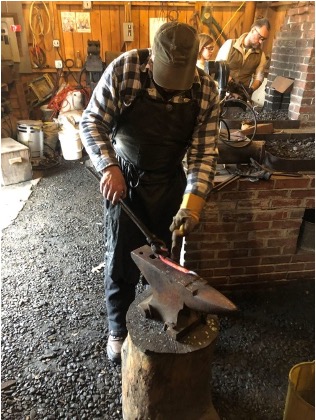
Blacksmithing at the Homestead!
The 19th Century Curran Village is offering a two-day basic blacksmithing course at the 372 Fields Pond Road smithy in Orrington. The dates are December 12 & 13, 2026 and the course fee is $295. (9am to 4pm) All tools and materials are supplied, but students are advised to bring lunch and drinks and are urged to dress warmly in non-synthetic clothing.
Class size is limited to six, and participants are required to pre-pay for their slots. Payment may be made in cash, check, or credit card through Irv Marsters at the Bangor Letter Shop. For more information, contact Dick Stockford at 207-735-8976.
Photo Album


Student Information:
- All students for our Beginning Blacksmithing Workshop and Knife Making Workshop must be at least 15 years of age. We can offer a one-day blacksmithing workshop for ages 11-15 as well as adult/child workshops in which two can take a class for the price of one; parents serve in a mentoring capacity allowing the instructor to evenly distribute instruction time to all members of the class. Check our calendar for these types of workshops.
- It is recommended that blacksmithing/blade-smithing students wear leather shoes, cotton or wool clothing (not man-made clothing), work gloves, ear plugs (optional) and, most importantly, eyewear.
- Students will bring a 2. – 2.5 lb. lb. ball, cross or straight pein or machinist’s drilling type hammer. Always wear safety glasses with side shields, ear plugs (optional), leather work gloves, leather shoes, and natural fiber clothing. Ear plugs might be a good idea.
- Fill out a “Waiver of Liability” form before you begin blacksmithing at one of our smithies. If you are injured, you need to inform the instructor or the overseer of the smithy at that time. We have a first-aid kit on premises.
- Always treat tools in the smithy as your own. No tools are to leave the smithy without the permission of the museum director of 19th Century Curran Village.
- Clean forge after using it is important to everyone using the smithy. As part of the course you will learn to recognize the difference between coal, coke, and clinker. All of these materials should be treated accordingly. Coke is used to start your forge fire, coal is used to fuel your fire, and clinker is the inevitable waste of the coal fire. Clinker should be cleaned from the fire pan after each use; it is to be put into a metal bucket. Coke can be used when starting forge fires and should be placed in a metal bucket under the forge for later use. Clinker is to be dumped in a place designated by the instructor when the pail containing it is full.


